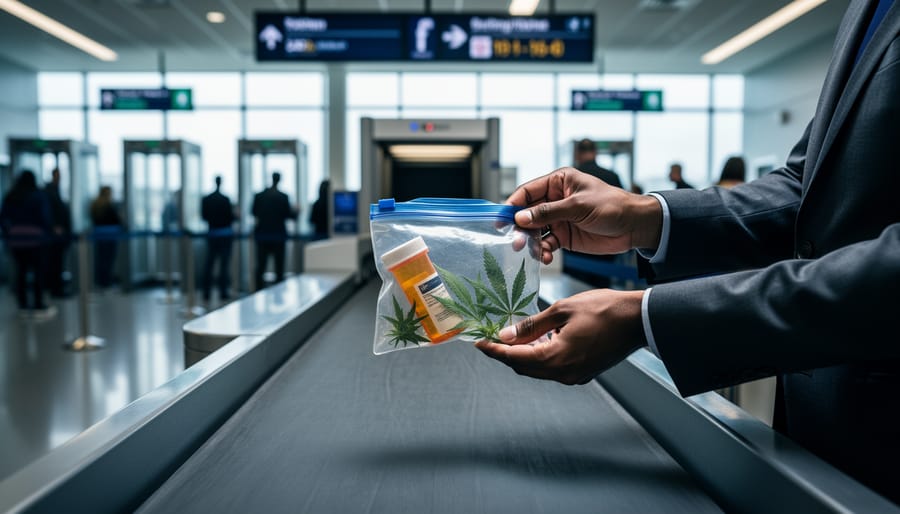
Can You Travel on a Plane with Medical Marijuana? Here’s What Actually Happens
No, you cannot legally fly with medical marijuana in the United States, even with a valid state-issued medical card. Federal law still classifies cannabis as a Schedule I controlled substance, which means the Transportation Security Administration (TSA) operates under federal regulations that prohibit it on all flights, regardless of departure or destination state laws.
This creates a confusing situation for medical cannabis patients. You might live in California where your prescription is perfectly legal, and you might be flying to Colorado where recreational cannabis is also legal, but the moment you pass through TSA security at a federally regulated airport, you’re subject to federal law. The same applies to all U.S. airspace and any international flight.
Here’s where it gets more nuanced: TSA agents aren’t actively searching for your cannabis products. Their primary focus is security threats like weapons and explosives. TSA’s official policy, updated and clarified over the years, states that if officers discover marijuana during screening, they’re required to refer the matter to law enforcement, typically local or airport police. What happens next depends on which officers respond and where you are.
Medical cannabis patients face real challenges when traveling. Some have reported simply having their products confiscated without further consequences at airports in cannabis-friendly states. Others have faced citations, missed flights, or more serious legal trouble, particularly in states with stricter enforcement or when crossing international borders. The outcome is unpredictable and depends on factors entirely outside your control.
This guide walks through the specific regulations, what actually happens at security, your options for domestic versus international travel, and practical alternatives that keep you legal while managing your medical needs on the road.
The Federal vs. State Law Conflict Explained
Here’s the thing about medical marijuana and air travel: you’re caught in a legal twilight zone. Cannabis remains a Schedule I controlled substance under federal law, meaning the U.S. government classifies it alongside heroin and LSD with no recognized medical use. Meanwhile, 38 states have legalized medical marijuana, and many have thriving dispensaries and patient programs. Your state might treat your medical card as legitimate documentation for legal cannabis use, but federal law sees it differently.
This creates real confusion at airports because aviation exists entirely in federal territory. The moment you step into an airport terminal, you’re on federal property governed by federal law. The same applies to the aircraft itself and the airspace it flies through. Your state-issued medical marijuana card, no matter how legitimate, doesn’t change that federal classification. It’s like having a driver’s license that’s valid in your state but not recognized by the interstate highway system you’re about to drive on.
Airlines face the same federal constraints. Delta, United, and Southwest all operate under Federal Aviation Administration regulations, which means they’re bound by federal drug policies even when flying between two states where marijuana is legal. A flight from Denver to Los Angeles might connect two cannabis-friendly states, but it’s still a federally regulated flight where cannabis possession technically violates the rules.
This federal-state conflict means there’s no straightforward answer to whether you can fly with medical marijuana. The legality depends on which legal framework you’re asking about, and unfortunately for travelers, airports default to the stricter federal standard.
TSA’s Current Screening Policy on Medical Marijuana
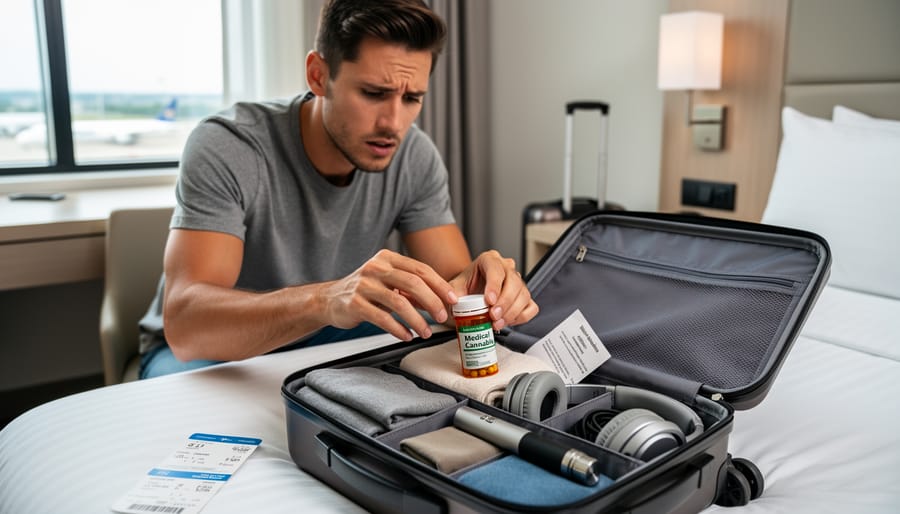
TSA officers aren’t hunting for your medical marijuana. Their job is finding weapons, explosives, and other security threats that could endanger a flight. When they screen your bags, they’re looking at X-ray images for shapes and densities that suggest danger, not analyzing every substance for legality.
That said, if a TSA officer spots something that looks like cannabis during screening, they’re required to follow protocol. According to TSA’s official stance, they don’t search for marijuana or other drugs, but if any illegal substance is discovered during security screening, they refer the matter to law enforcement. This is where things get complicated. The officer will call over a local or airport police officer, who then decides what happens next based on local laws and federal rules on cannabis.
What actually happens varies wildly by airport. At Denver International or LAX, where local laws permit marijuana possession, police often just ask you to throw it away or take it back to your car. You might miss your flight, but you’re unlikely to face arrest. At airports in states where cannabis remains fully illegal, the outcome can be harsher: citations, confiscation, or even arrest, particularly if you’re carrying large quantities.
The volume matters too. A vape cartridge or small container of oil draws less attention than a bag full of flower. TSA processes millions of passengers daily, and officers use discretion. Many choose not to call law enforcement over small personal amounts, especially at airports in legal states. But counting on an officer’s discretion is a gamble. There’s no standard national policy, just individuals making judgment calls under pressure.
Your medical card might help your case with local police, but it holds no weight with TSA or federal authorities. The screening checkpoint is federal jurisdiction, and federally, all cannabis is still illegal regardless of your documentation.
Domestic Flights Within the United States
Airports That Allow Medical Marijuana
Several airports in cannabis-legal states have adopted policies that acknowledge medical marijuana possession within their terminals, but these policies come with crucial limitations that confuse many travelers.
Los Angeles International (LAX) and other California airports allow passengers over 21 to possess cannabis within the airport in amounts permitted under state law. Denver International similarly permits possession of small amounts consistent with Colorado state law. Seattle-Tacoma International doesn’t prohibit possession of cannabis in quantities legal under Washington state law. These airport policies reflect local law enforcement priorities, not a green light for air travel.
Here’s the critical part most travelers misunderstand: these airport policies only govern what happens on airport property under local jurisdiction. They don’t change federal law, don’t bind TSA screeners, and offer zero protection once you’re airborne or land elsewhere. An airport policy that won’t arrest you for possession is fundamentally different from permission to board a flight with cannabis.
Think of it this way: the airport won’t call police if they find you with medical marijuana in the terminal, but TSA still operates under federal guidelines. If screeners find cannabis during security screening, they’re required to refer the matter to law enforcement, even if that same law enforcement has a policy of non-enforcement. The airport’s tolerance ends where the checkpoint begins.
These policies address the awkward reality that millions of legal cannabis users pass through these airports, but they don’t resolve the federal conflict that governs actual flight.
What Your Medical Card Actually Covers
Your medical marijuana card proves you’re legally authorized to use cannabis in your home state. On an airplane, though, its protection essentially ends at the airport entrance.
State medical cards have zero authority on federal property, which includes TSA checkpoints and the aircraft itself. Even at airports in states like California or Colorado that technically allow medical marijuana within the terminal, your card doesn’t create any legal shield once you’re interacting with federal employees or crossing into federal jurisdiction. TSA agents, working under federal authority, aren’t bound by state medical marijuana laws regardless of what your card says.
The interstate recognition issue complicates things further. Only about 20 states have medical marijuana reciprocity agreements that recognize out-of-state cards. If you’re flying from a reciprocity state to one that doesn’t accept your card, you could legally possess cannabis at departure but become a criminal the moment you land. Your card covers you in neither the federal airspace between them nor at the arrival airport.
Some travelers assume medical documentation, a doctor’s letter, prescription details, or official state paperwork, provides legal coverage. It doesn’t. Federal law classifies marijuana as a Schedule I controlled substance with no accepted medical use, meaning federal authorities don’t recognize any medical justification for possession. A DEA agent or federal prosecutor wouldn’t accept your state medical card as a defense, period.
The card’s real value when flying is minimal: it might help explain your situation to local law enforcement if TSA refers you to them at an airport in a medical state. That’s the extent of its protection.
International Flights and Border Crossings
International travel with medical marijuana operates in an entirely different legal universe than domestic U.S. flights. The answer is straightforward: don’t do it. The consequences range from serious to catastrophic.
When you cross an international border, you’re subject to the laws of both countries and international treaties. Cannabis remains illegal in most countries worldwide, and many nations impose severe penalties for drug possession regardless of medical status. Countries like Singapore, the United Arab Emirates, Japan, and Indonesia enforce mandatory prison sentences for even small amounts of cannabis. Your state-issued medical card means absolutely nothing at foreign customs.
U.S. Customs and Border Protection takes cannabis violations seriously at both entry and exit points. If you’re caught leaving the U.S. with cannabis, you can face federal charges. If you’re caught entering from abroad, you’re looking at criminal prosecution plus potential travel bans. The agency maintains records of drug violations that can affect your ability to cross borders for years.
Even traveling to Canada presents risks most people don’t anticipate. While Canada legalized cannabis federally, you still cannot legally transport it across the U.S.-Canada border in either direction. Both countries’ border agencies actively screen for cannabis, and being caught can result in denial of entry, seizure of your products, fines, and a permanent record that complicates future travel.
Some travelers assume that flying between two countries where cannabis is legal creates a safe corridor. This is false. International airspace and customs zones operate under separate regulations. You’re crossing a federal border, which triggers enforcement mechanisms that don’t care about either country’s domestic policies.
The risk-to-benefit calculation for international travel is simple: the legal exposure is exponentially higher than domestic flights, and the consequences can include incarceration abroad, where U.S. legal protections don’t apply. Medical necessity isn’t recognized as a defense in most international jurisdictions.
Different Forms of Medical Cannabis and Screening
Different product forms trigger varying levels of scrutiny at TSA checkpoints, and understanding these distinctions helps you assess which options might pass through screening more smoothly.
Flower or raw cannabis creates the most obvious detection issues. X-ray machines highlight dense organic material, and the distinctive appearance of buds in luggage immediately flags screener attention. Even in sealed containers, flower is the easiest form for TSA agents to identify and the hardest to explain away as anything else.
Oils and tinctures blend into the broader category of liquids, which gives them a degree of anonymity during screening. TSA’s 3-1-1 rule applies: containers must hold 3.4 ounces or less in carry-on bags, though larger bottles can go in checked luggage. A small dropper bottle of cannabis oil looks identical to CBD oil, vitamin tinctures, or essential oils on an X-ray. Screeners rarely test liquid contents unless something else raises suspicion.
Edibles present a middle ground. Gummies, chocolates, and baked goods appear as ordinary snacks on screening equipment. The challenge comes if a screener physically inspects your bag for another reason and notices cannabis-themed packaging or labeling. Removing products from dispensary packaging and placing them in generic containers reduces this risk, though it also removes your proof of legal purchase.
| Product Type | Screening Considerations | Detection Risk |
|---|---|---|
| Flower/Buds | Highly visible on X-ray, distinctive appearance | High |
| Oils/Tinctures | Blend with other liquids, follow 3-1-1 rule | Low-Medium |
| Edibles | Appear as regular food, packaging is key factor | Medium |
| Topicals | Indistinguishable from lotions and creams | Low |
| Vape Cartridges | Must follow battery rules, liquid limits apply | Medium |
Topicals like balms, lotions, and transdermal patches are the lowest-risk option for screening purposes. They look identical to conventional skincare products and raise no red flags during X-ray scanning.
Vape cartridges and pens occupy complicated territory. Battery-powered devices must go in carry-on bags per FAA rules, and if you travel with vape gear regularly, you know screeners focus on battery safety rather than cartridge contents. That said, cannabis vape cartridges can smell when opened or damaged, and screeners occasionally ask travelers to demonstrate vape setup and use if the device looks unfamiliar. Cartridges without THC labeling draw less attention than those clearly marked with cannabinoid percentages.
The form you choose affects not just detection likelihood but also how you’d explain the item if questioned.
Practical Steps If You Decide to Fly with Medical Marijuana
If you’re choosing to travel with medical marijuana despite the legal gray areas, these steps can help minimize complications, though they don’t eliminate risk entirely.
Start by researching your specific route. Check the departure airport’s website for their official policy on cannabis, then do the same for your destination airport. Some airports post explicit guidance; others stay silent. Look up whether your destination state has medical reciprocity with your home state, though remember this doesn’t change federal jurisdiction over airports.
Carry your medical documentation. Keep your state-issued medical marijuana card in your wallet and a copy of your physician’s recommendation with you. While these won’t override federal law, they can clarify your situation if questioned by local authorities who have discretion in enforcement.
Package products carefully. Keep items in their original, labeled dispensary packaging when possible, this shows medical legitimacy rather than recreational use. For oils and tinctures, ensure they meet TSA’s liquid rules (3.4 ounces or less in carry-on). If you fly with vape devices the same battery safety rules apply to cannabis pens.
Consider your quantity. Carrying a small, clearly medical amount looks different than traveling with large quantities that suggest distribution. Stick to what you genuinely need for your trip.
Be prepared to surrender it. If TSA finds your cannabis and refers the matter to local law enforcement, know that you might need to dispose of it on the spot. Some airports have amnesty boxes for this purpose. Decide in advance whether you’re willing to give it up rather than miss your flight or face arrest.
Alternatives to Consider
If traveling with medical marijuana feels too risky or complicated for your situation, several alternatives can help you manage symptoms while staying within legal boundaries.
Research dispensaries at your destination. Most states with medical programs offer temporary patient provisions or reciprocity for out-of-state cards. California, for example, allows anyone 21+ to purchase from recreational dispensaries, while states like Arizona and Nevada honor medical cards from other states. Call ahead to confirm requirements and product availability before you check flight status for your trip.
Consider CBD products as a legal substitute. Hemp-derived CBD containing less than 0.3% THC is federally legal and widely available. While not identical to THC-based treatments, many patients find CBD helps manage pain, anxiety, and inflammation during travel. These products clear TSA screening without issue.
Talk to your doctor about temporary alternatives. Some patients successfully use prescription medications for short trips, though this requires advance planning and isn’t suitable for everyone. Your healthcare provider can suggest options that match your specific conditions.
Never mail cannabis products. Despite what you might read online, shipping marijuana through USPS, FedEx, or UPS remains a federal crime regardless of state laws. The risk far outweighs any convenience, potentially resulting in felony charges.
Frequently Asked Questions
Does it matter if I pack medical marijuana in checked luggage or carry-on?
Not really. TSA screens both checked and carry-on bags, and their policy doesn’t distinguish between the two. Some travelers assume checked bags offer more privacy, but screeners flag suspicious items in either location.
Can I fly with a medical marijuana vape pen?
Vape devices themselves are allowed, but they must go in carry-on bags due to battery rules. The cannabis oil cartridge remains federally illegal regardless of where you pack it, though TSA may not differentiate it from nicotine vapes during screening.
What actually happens if TSA finds my cannabis?
TSA agents typically call airport or local police to the screening area. What happens next depends entirely on that jurisdiction’s laws and the officer’s discretion. At some airports in legal states, they may let you dispose of it or leave the airport. At others, you could face arrest.
Will flight attendants or airline staff report me if they notice cannabis?
Airline crew can report suspected illegal activity, but they’re not actively searching passengers. The bigger risk comes during boarding delays or gate changes when you might need to handle flight delays in areas with stricter enforcement.
The honest answer to most of these questions is that outcomes vary wildly based on your specific airport, the officer who responds, and whether you’re flying domestically or internationally. No frequent flyer advice or online forum anecdote can predict what enforcement you’ll actually face.
Flying with medical marijuana means navigating a gap between legitimate medical need and real legal risk. There’s no perfectly safe approach. Even airports that permit cannabis on their property can’t override federal law or control what happens at your destination. State medical cards provide some protection locally but offer no guarantees during air travel.
Your decision should weigh your specific route, medical requirements, and comfort with uncertainty. A flight within California carries different risks than one from Denver to Texas. International travel adds another layer of serious legal consequences that domestic flights don’t.
Laws keep changing. Airport policies shift. What worked last year might not work now, and what’s standard at one airport may be unusual at another. Before any trip, verify current rules for both your departure and arrival airports. Check whether your destination state has reciprocity for out-of-state medical cards. Research whether dispensaries operate where you’re going.
Make the choice that fits your situation, but make it with open eyes. The landscape is messy, the rules sometimes contradict each other, and ultimately you’re responsible for understanding the legal framework you’re stepping into.