
How to Say Hello in Spanish: Quick Translation Guide for Travelers
Looking to translate “hello” into Spanish? The answer is “hola” (pronounced OH-lah), and you’ll use it in virtually every Spanish-speaking country from Mexico to Argentina. This single word opens doors, earns smiles, and transforms you from tourist to traveler the moment it leaves your lips.
I learned this firsthand during a chaotic arrival in Barcelona when my luggage went missing. Instead of fumbling through English at the baggage claim desk, I opened with a confident “hola” and watched the attendant’s entire demeanor shift. That one word signaled respect for the local culture and made the entire interaction smoother, even though I had to switch to broken Spanish-English for the actual problem-solving.
The beauty of “hola” is its versatility. Unlike English, where “hello” can sound stiff in casual settings, “hola” works whether you’re greeting a street vendor in Oaxaca or checking into a boutique hotel in Madrid. You’ll hear it dozens of times daily, making it one of the easiest words to practice and perfect through immersion.
Most travelers searching for this translation are doing exactly what you’re doing right now: preparing for a trip and wanting to make genuine connections abroad. Translation tools are now live in 33 languages, but memorizing this essential greeting beforehand means you won’t fumble with your phone during those crucial first impressions at customs, restaurants, or when asking directions. Learning “hello” in the local language truly enhances your experience abroad, and mastering the pronunciation takes less than five minutes of practice.
What You Need to Get Started
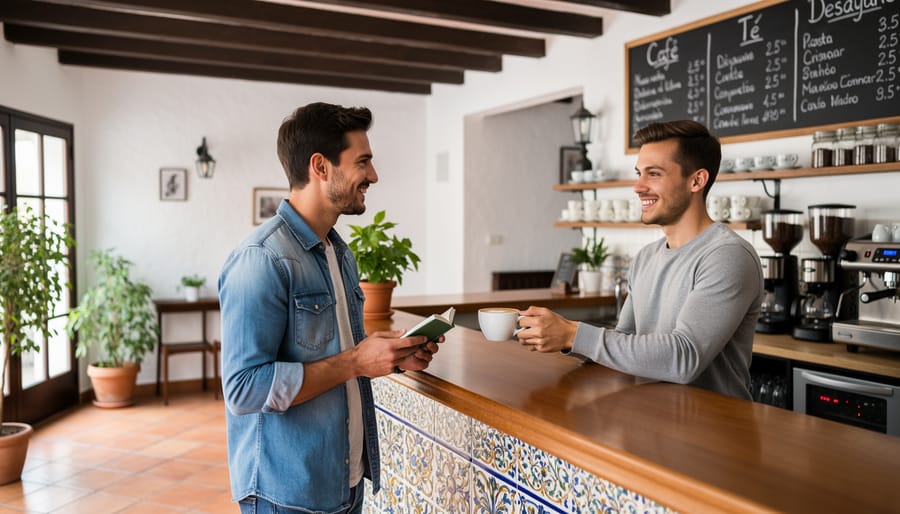
Good news: you already own everything you need to start speaking Spanish greetings. There’s no equipment to buy, no enrollment required, and you don’t need formal training to master “hola.” Your most valuable asset is the willingness to step outside your comfort zone and practice with real people, whether you travel solo or with companions.
That said, a few simple resources can speed up your learning. Modern translation apps support 33 languages and provide instant access to pronunciation guides, but they work best as reference tools rather than crutches. Consider keeping one of these handy:
- Translation apps with audio playback for hearing native pronunciation
- Phrasebooks that show phonetic spellings alongside Spanish text
- YouTube channels or podcast episodes focused on basic Spanish greetings
- Language exchange apps where you can practice with native speakers before your trip
Beyond tools, you’ll need context awareness. Spanish greetings shift based on the formality of your situation, what works perfectly at a hostel breakfast might feel too casual when checking into a business hotel. Pay attention to how locals greet each other in different settings, and you’ll quickly develop an instinct for matching your approach to the moment. The real learning happens when you observe, listen, and adjust on the fly during your travels.
When to Use (and Skip) ‘Hola’
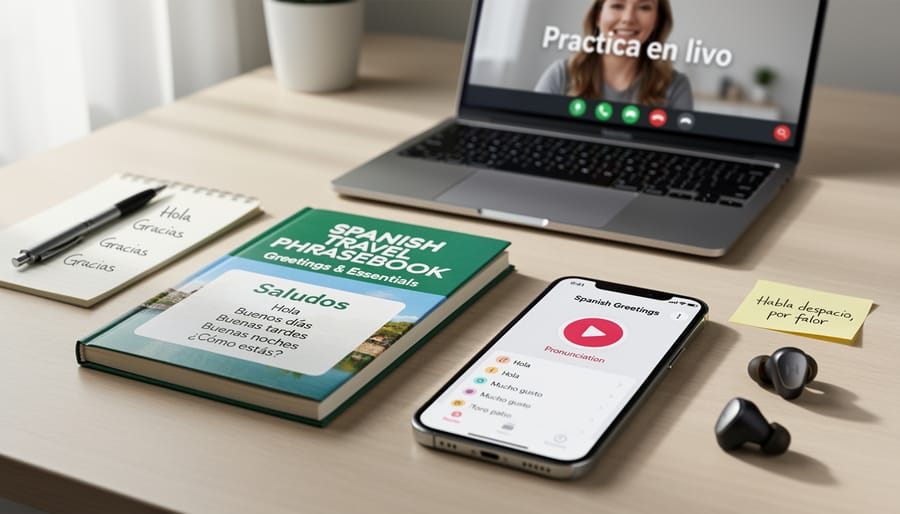
‘Hola’ works perfectly in most everyday travel situations, from greeting hostel staff to thanking a street vendor or chatting with fellow travelers. It’s your go-to for casual interactions, and you’ll find it warmly received across markets, cafes, tour groups, and informal conversations with locals your own age or younger.
However, certain contexts call for more formal greetings. Business meetings, upscale restaurants, government offices, and initial interactions with older adults warrant ‘buenos días’ (good morning), ‘buenas tardes’ (good afternoon), or ‘buenas noches’ (good evening) instead. When checking into a higher-end hotel or meeting someone for the first time in a professional setting, starting with a time-specific greeting shows cultural awareness and respect.
Regional variations matter less for ‘hola’ than for other expressions, since it’s universally understood from Mexico to Argentina. Still, you’ll notice local preferences: Spaniards often jump straight to conversation after ‘hola’, while many Latin American cultures pair it with a handshake or cheek kiss depending on familiarity.
The biggest mistake isn’t pronunciation, it’s persistence. If someone responds with a formal greeting or switches to English, they’re signaling a preference. Read the cues and adjust accordingly rather than forcing informality. Just like your security checklist helps you navigate airport protocols, understanding greeting protocols prevents awkward cultural missteps that could color your entire interaction.
When in doubt, observe how locals greet each other in similar settings, then mirror that energy and formality level.
Step-by-Step: Mastering Your Spanish Hello
Pronunciation Made Simple
The secret to pronouncing “hola” correctly is simpler than you think: OH-lah. Two syllables, with the stress on that first one. The “h” is silent (just like in “honest”), so you’re really saying “ola.” Think of it as opening your mouth to say “oh” and following through with a soft “lah.”
English speakers typically stumble in two ways. First, they pronounce the “h” like they would in “hello,” creating an awkward sound that immediately flags them as beginners. Second, they rush through it as one syllable (“oh-la” becomes “ola”), losing the natural rhythm that makes it sound authentic.
Here’s a quick practice method I picked up in a Madrid café: say “oh” like you’re expressing pleasant surprise, pause for a beat, then add “lah” as if you’re singing a musical scale. The Wiktionary pronunciation of hola confirms this two-syllable approach.
Try this: record yourself saying it, then play it back. Does it sound relaxed and open, or clipped and harsh? Spanish vowels are pure and full, not the diphthongs we use in English. Your “o” should stay round and clear from start to finish, never sliding into an “ow” sound.
Reading the Room: Context Clues
The setting tells you which greeting fits best. In upscale hotels, business meetings, or formal restaurants, you’ll notice locals using “buenos días” or “buenas tardes” more than a casual “hola.” Listen for cues: if the hotel concierge greets you with “buenos días,” mirror that formality rather than jumping straight to “hola.”
Markets, cafés, and casual restaurants are hola territory. Watch how vendors greet regular customers, you’ll hear plenty of relaxed “¡hola!” exchanges paired with smiles. When a shopkeeper opens with “hola,” you’re in informal space where friendly beats formal.
Age and hierarchy matter too. Older adults or people in positions of authority (customs officers, bank staff, government workers) typically expect “buenos días” until they signal otherwise. Younger people and peers? Hola works perfectly.
The real trick is observing first. Spend your first interaction listening to how staff greet other customers. In a Barcelona tapas bar, I watched the bartender say “hola” to a young couple but “buenas tardes” to an elderly patron. That pattern told me everything I needed about reading the room and adjusting accordingly.
Beyond ‘Hola’: Essential Follow-Up Phrases

Once you’ve greeted someone with “hola,” you’ll want to keep the conversation flowing naturally. The most common follow-up is asking how someone is doing, but which version you choose matters.
For casual situations, use “¿Cómo estás?” (KOH-moh ess-TAHS). This informal version works perfectly with peers, young people, fellow travelers, or anyone you’d normally address casually. When interacting with service staff, older individuals, or in professional settings, switch to “¿Cómo está?” (KOH-moh ess-TAH), which shows appropriate respect through the formal “usted” form.
You’ll typically hear responses like “bien, gracias” (well, thanks) or “muy bien, ¿y tú?” (very well, and you?). A simple “bien, gracias” covers most situations when someone asks you first.
Learning these basic conversational bridges transforms your interactions from tourist transactions into genuine moments of connection. I’ve found that making even a small effort to speak Spanish often leads locals to share recommendations you won’t find in guidebooks, whether that’s directions to authentic neighborhood restaurants or tips for navigating public transport maps in unfamiliar cities.
Two more phrases worth adding to your travel toolkit: “Por favor” (please) and “Gracias” (thank you). Pair “hola” with these basics, and you’ve covered the essential courtesy framework that opens doors throughout Spanish-speaking destinations.
The real value isn’t achieving perfect fluency. It’s demonstrating respect for local culture and willingness to meet people halfway. That small gesture of attempting their language, even imperfectly, creates warmer welcomes and richer travel memories than any translation app alone can provide.
Testing Your Skills: How to Know You’re Doing It Right
You’ll know you’re getting it right when locals respond with a smile and continue the conversation in Spanish rather than switching to English. That immediate warmth signals you’ve nailed both the pronunciation and the delivery. Pay attention to whether people lean in and engage or offer a polite but quick response, the former means you’re doing great.
To self-assess your pronunciation before your trip, record yourself saying “hola” and compare it to native speaker videos. The ‘h’ should be completely silent, and the stress falls naturally on the first syllable. If you’re hearing yourself say “ho-LA” instead of “OH-lah,” keep practicing. Ask Spanish-speaking friends or language exchange partners for honest feedback, they’ll catch subtle errors you might miss.
Practice in low-stakes situations first. Start with hotel staff, cafe servers, or museum attendants rather than jumping into complex business meetings. Each successful interaction builds confidence. I practiced my greetings while running through airport tips for my Mexico City trip, repeating phrases during the long security lines until they felt natural.
Once “hola” feels comfortable, layer in “buenos días” for mornings and “¿Cómo está?” for slightly more formal exchanges. The real test comes when someone responds with rapid Spanish and you catch enough to continue the conversation, even if it’s just nodding and saying “sí” or “gracias.” That’s when you know you’ve moved beyond tourist basics into genuine connection.
Common Questions About Spanish Greetings
Travelers often have similar questions when they start using Spanish greetings. Here are the answers to what comes up most.
Is ‘hola’ used in all Spanish-speaking countries?
Yes, ‘hola’ is universally understood and used across every Spanish-speaking country, from Mexico to Argentina to Spain. While regional slang exists, ‘hola’ works everywhere and won’t confuse anyone.
What’s the difference between ‘hola’ and ‘buenos días’?
‘Hola’ is an all-purpose greeting you can use anytime, while ‘buenos días’ (good morning) is time-specific and slightly more formal. Many locals combine them: “Hola, buenos días” for a friendly yet respectful morning greeting.
Can I use ‘hola’ in business settings?
In most business contexts, pair ‘hola’ with a formal follow-up like ‘¿Cómo está?’ rather than using it alone. For very formal situations like job interviews or meeting senior executives, start with ‘Buenos días’ or ‘Buenas tardes’ instead.
How do I respond when someone says ‘hola’ to me?
Simply say ‘hola’ back with a smile. You can add ‘¿Qué tal?’ (What’s up?) or ‘¿Cómo estás?’ (How are you?) if you want to continue the conversation, but mirroring their greeting is perfectly acceptable.
One question I hear constantly: do you really need more than ‘hola’ to travel comfortably? Honestly, no. Learning to say hello in the local language opens doors, but you can travel through Spanish-speaking countries with just a handful of phrases. That said, adding ‘gracias’ (thank you), ‘por favor’ (please), and basic numbers makes daily interactions smoother and shows respect for local culture. I’ve watched travelers connect with locals using nothing more than ‘hola’ and genuine warmth, proving that attitude matters as much as vocabulary. The beauty of starting with ‘hola’ is that it builds confidence for learning more, turning what feels like a language barrier into an invitation to engage.
Learning to say hello in Spanish isn’t about achieving fluency, it’s about connection. That simple “hola” you practiced on the plane? It transforms you from tourist to traveler the moment it leaves your lips.
I’ve watched countless interactions shift when someone makes the effort to greet locals in their language. The shopkeeper in Mexico City who suddenly shares her favorite taco stand. The hotel clerk in Barcelona who upgrades your room. The grandmother in Lima who insists you try her homemade ceviche. These moments don’t happen because your pronunciation is perfect. They happen because you tried.
Start practicing now, even if your trip is months away. Say it while making coffee. Whisper it in the shower. The muscle memory you build today becomes confidence tomorrow when you’re actually standing in that Madrid café or wandering through Cartagena’s old town.
Respectful travel starts with small gestures. Learning hello in the local language signals that you see the people you’re visiting as more than scenery. You’re acknowledging their culture, their language, their humanity. And that one word, simple, accessible, powerful, opens doors to experiences no guidebook can replicate. Your next Spanish-speaking adventure is waiting. Go say hello.