What Meals Are Served on American Airlines International Flights? 2026 Menu Guide & Airline Comparison
If you’re booking international travel in 2026 and wondering whether American Airlines delivers on dining, the short answer is yes for premium cabins, but you’ll find stronger overall value with Singapore Airlines, Emirates, or Japan Airlines across all classes. We’ve flown these seven carriers extensively to compare their meal programs, and what we found surprised us: American has genuinely stepped up its game this year with caviar service and standout entrees like Sweet Chile Sea Bass in Flagship Business, but it still ranks fifth overall because competitors offer more consistent quality from economy through first class.
Here’s why this matters for your trip planning. Most travelers searching for American’s international menu aren’t just curious about the food itself. You’re comparing airlines, weighing whether to book American’s transatlantic flight or pay a bit more for Emirates, and trying to figure out if the meal service justifies loyalty program choices. I’ve sat through enough rubbery pasta at 35,000 feet to know that dining can make or break a long-haul experience, especially when you’re crossing multiple time zones and relying on meals to help reset your body clock.
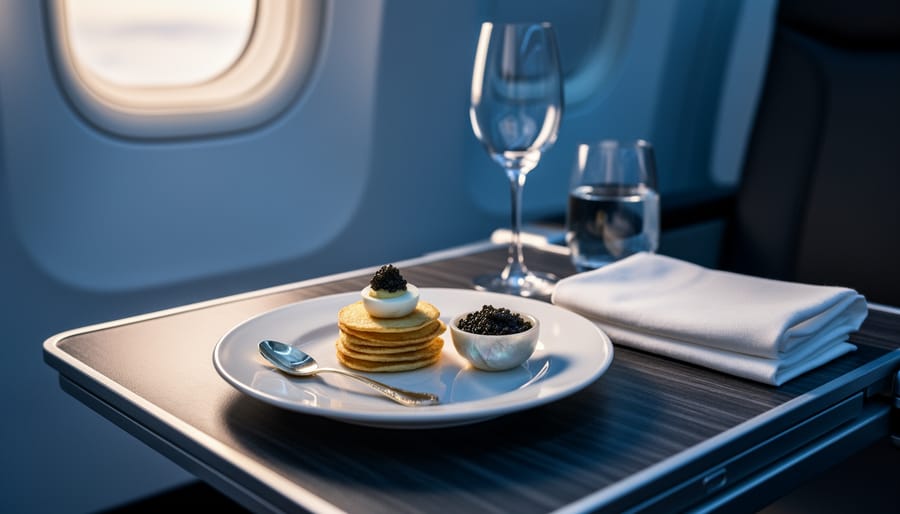
American rolled out significant changes starting May 1, 2026, including a Main Cabin refresh with the new “Inflight Bites” box and premium enhancements like blinis paired with creme fraiche-topped deviled eggs in Flagship cabins. We tested these updates on routes to Europe and Asia, comparing them side-by-side with what Singapore’s Suites Class, Emirates’ business service, and JAL’s seasonal menus deliver.
This roundup walks you through the seven best international carriers for meals right now, with detailed breakdowns of what you’ll actually eat in each cabin, practical tips for maximizing your inflight dining experience, and honest assessments of where each airline excels or falls short.
Why In-Flight Meals Matter on International Flights
On a twelve-hour flight to Tokyo, I remember waking from an uncomfortable nap, disoriented and hungry. The flight attendant appeared with a warm meal tray, and that simple act of being fed something decent at 35,000 feet reset my entire mood. I slept better afterward, arrived less drained, and actually enjoyed the second half of the journey. That experience taught me what many frequent long-haul travelers already know: meal service isn’t a luxury detail on international flights. It’s fundamental to your comfort and well-being.
When you’re confined to a metal tube crossing oceans and time zones, food becomes more than sustenance. It breaks up the monotony of a fifteen-hour haul to Sydney, provides a reason to move and engage your senses, and gives your body cues about when to stay awake or wind down for sleep. Airlines know this, which is why premium cabins lean heavily on multi-course dining to justify their price tags. A properly timed meal can help you adjust to a new time zone before you land, while a poorly planned service can leave you wide awake when you should be resting.
Even in economy, where expectations run lower, a thoughtful meal makes the experience tolerable rather than something to endure. The difference between a sad sandwich and a decent curry with vegetables can genuinely affect whether you arrive energized or exhausted.
Quick Comparison: Top Airlines for International Meal Service
When comparing which airlines serve meals worth writing home about, a quick side-by-side view helps. We’ve flown all seven carriers on long-haul routes and evaluated their current service standards, from economy trays to first-class caviar. The table below spotlights what each airline does best and where they shine brightest, making it easy to match your route and budget to the carrier that delivers the best in-flight meals for your priorities.
| Airline | Standout Feature | Best Cabin for Meals | Typical Routes |
|---|---|---|---|
| Singapore Airlines | Book the Cook pre-order program, regional specialties | All cabins (Suites to Economy) | Asia-Pacific, Europe, US West Coast |
| Emirates | Caviar on demand, onboard bar service | First and Business Class | Middle East hub to global destinations |
| Japan Airlines | Seasonal kaiseki meals, Air Series tableware | Business and Premium Economy | Trans-Pacific, intra-Asia |
| Turkish Airlines | Flying Chefs, extensive menu variety | Business Class | Europe, Middle East, Asia via Istanbul |
| American Airlines | 2026 caviar service, Sweet Chile Sea Bass | Flagship First and Business | Trans-Atlantic, Trans-Pacific, Latin America |
| Qatar Airways | Qsuite dining, mezze selections | Business Class | Middle East hub to worldwide network |
| Air France | French chef partnerships, regional cheeses | La Première and Business | Trans-Atlantic, intra-Europe, Africa |
Singapore Airlines consistently impresses across all cabin classes, while Emirates and Air France lean heavily into premium luxury. American’s 2026 upgrades have narrowed the gap in premium cabins, particularly with the April caviar rollout.
How We Ranked These Airlines
We judged these seven carriers against a clear set of benchmarks after tracking their meal service across multiple routes and cabin classes throughout 2025 and into 2026. Rather than relying solely on marketing claims, we weighted actual passenger experiences, menu documentation, and verified service enhancements to build an accurate picture of what travelers can genuinely expect when they board.
Our rankings reflect six core criteria:
- Menu creativity and variety: originality of dishes, regional authenticity, and breadth of choice within each cabin
- Ingredient quality and presentation: freshness, sourcing standards, and visual appeal of plating
- Cabin-specific differentiation: how well premium cabins deliver elevated dining versus economy offerings
- Dietary accommodation: ease of pre-ordering special meals and how well carriers handle restrictions
- Service consistency: reliability of meal quality across different routes and seasons
- Recent improvements: tangible 2026 enhancements like American’s April caviar rollout in Flagship First and Business or the May Main Cabin refresh
We gave particular weight to 2026 service updates because they signal a carrier’s commitment to staying competitive. American’s expanded meal routes and premium upgrades, for instance, moved them higher than they would have ranked on legacy menus alone. Each airline’s position reflects the complete picture, balancing long-standing strengths with current momentum.
The 7 Airlines with the Best International In-Flight Meals
1. Singapore Airlines: The Gold Standard for All Cabins
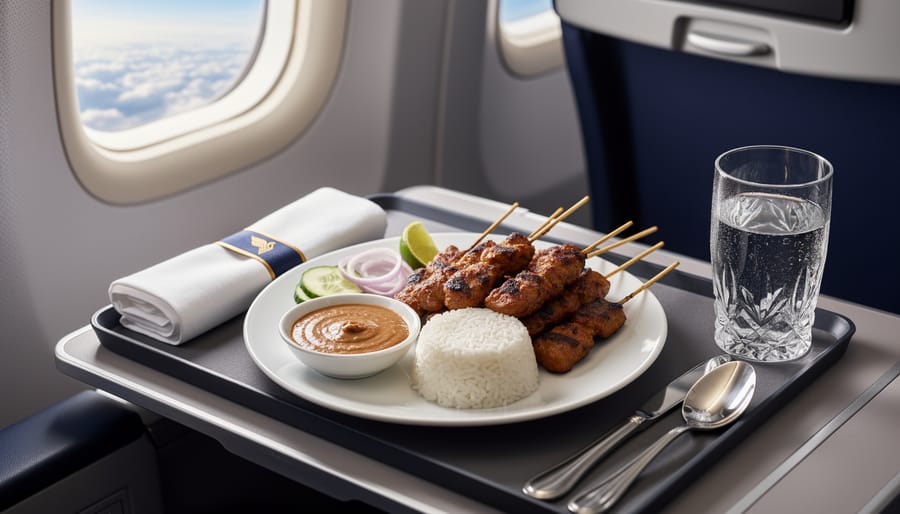
On our most recent Singapore-to-San Francisco leg, we watched the cabin crew wheel out gleaming satay carts mid-flight, filling the aisles with the scent of grilled meat and peanut sauce. That attention to theatre and flavor is exactly why Singapore Airlines consistently tops international meal rankings across every cabin class.
What sets Singapore apart is the Book the Cook program, which lets passengers pre-order from an extended menu curated by a rotating panel of international chefs. We’ve selected everything from lobster thermidor to Hainanese chicken rice weeks before departure, guaranteeing our first choice rather than settling for whatever remains when the cart reaches row 32. The program runs in premium economy, business, and Suites, giving travelers genuine restaurant-style choice at altitude.
Even in standard economy, where pre-ordering isn’t available, Singapore’s rotating menu offers regional depth you won’t find on most carriers. A typical long-haul service includes both Asian options (think nasi lemak or Japanese-style grilled fish) and Western mains like braised beef or chicken parmigiana, all plated with care. The airline sources ingredients specifically for route networks, so flights departing Asia feature genuinely fresh components rather than reheated Western approximations of regional cuisine.
In Suites and business class, the experience shifts to full multicourse service with tablecloths, proper glassware, and dishes from chefs like Georges Blanc and Shermay Lee. We’ve genuinely looked forward to the meal service on 14-hour flights because the execution matches the menu’s ambition. Presentation stays thoughtful, portions feel generous without being excessive, and the crew treats dining as a central part of the journey rather than an obligatory task to complete quickly.
Singapore Airlines proves that excellent food service doesn’t require sacrificing one cabin for another. Whether you’re in a lie-flat suite or a standard economy seat, the airline treats meals as worth doing properly.
2. Emirates: Luxury Dining at 40,000 Feet
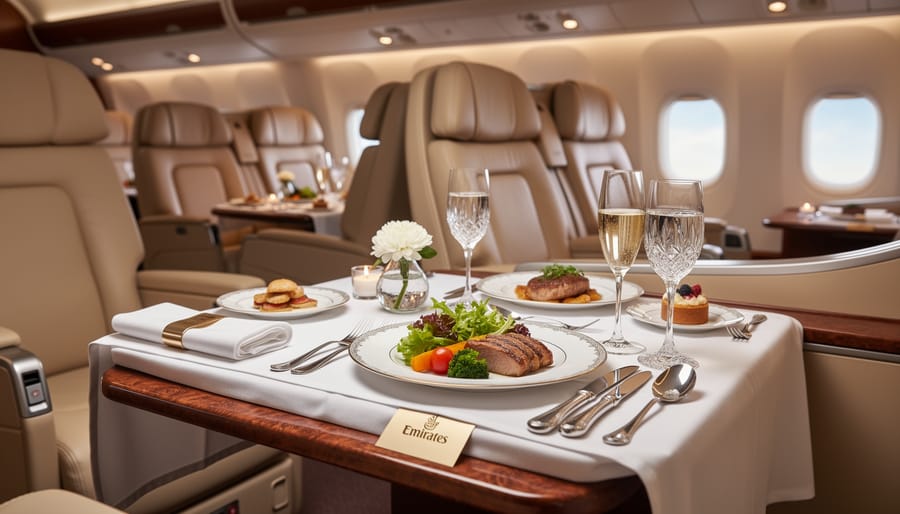
We discovered Emirates’ commitment to dining excellence firsthand on a Dubai-to-Sydney run, when a flight attendant in business class offered us caviar service at 2 a.m., and meant it. The airline treats meal service as theater, with white-glove presentation that feels more like a high-end restaurant than an aircraft galley.
Emirates’ first class passengers enjoy genuine multicourse dining with choices that shift based on route. On flights from the Middle East to North America, we’ve seen menus featuring seared lamb chops with rosemary jus alongside more familiar filet mignon options. The caviar comes on demand rather than at a fixed service time, paired with blinis, sour cream, and a selection from their extensive Champagne list. This flexibility matters on ultra-long routes where passengers sleep and wake on different schedules.
Business class maintains much of the same culinary ambition with slightly smaller portions. The signature onboard bar in A380 aircraft stocks premium spirits and encourages passengers to mix and socialize, something we’ve found genuinely transforms the middle hours of a 14-hour flight. Hot meals arrive plated rather than pre-assembled, and flight attendants pour sauces tableside when service flow allows.
What surprised us most was the economy cabin quality. Emirates sources ingredients regionally, so flights departing Dubai feature Middle Eastern mezze options and Arabic coffee service, while services from Asian hubs incorporate local flavors. We’ve had legitimately good biryani and Thai green curry in economy, dishes that show attention beyond just filling passengers up. The airline offers Hindu, kosher, and other special meals with advance notice, though we’ve learned these can be hit-or-miss depending on the catering station.
The consistency across their network stems from centralized catering facilities in Dubai that prepare most long-haul meals, ensuring quality control even on routes to secondary cities.
3. Japan Airlines (JAL): Where Culinary Tradition Meets Innovation
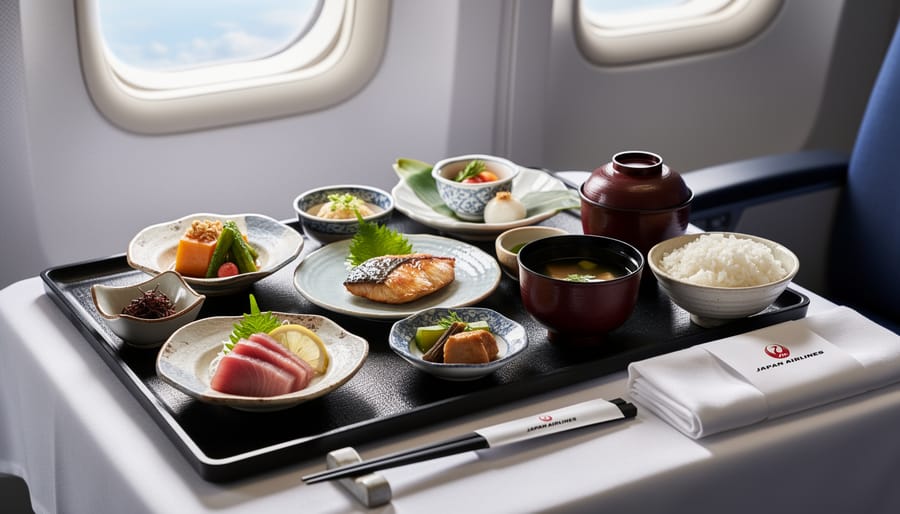
We still talk about the bowl of miso soup served on our JAL flight from Tokyo to San Francisco, not because it was particularly fancy, but because it arrived at the perfect temperature in a proper ceramic bowl, with tofu that hadn’t turned to rubber and scallions that still had bite. That attention to detail extends across JAL’s entire meal program, where presentation and seasonality matter as much in economy as they do in business class.
JAL built its meal service around the principles of washoku, traditional Japanese cuisine that emphasizes seasonal ingredients, visual harmony, and balance. Their seasonal kaiseki-inspired meals rotate quarterly to reflect what’s actually growing in Japan at that time. Spring routes might feature bamboo shoots and sakura-flavored desserts, while autumn brings chestnuts, persimmons, and matsutake mushrooms. Even the garnishes change with the calendar, which sounds precious until you realize how much more interesting it makes repeat travel on the same route.
The airline’s Air Series tableware collaboration with Japanese designers transforms meal service into something closer to a restaurant experience. The ceramic dishes, wooden chopstick rests, and carefully chosen serving vessels create a sense of occasion that plastic trays can’t match. We’ve found that this attention to presentation genuinely affects how the food tastes, or at least how much you notice and appreciate it during a twelve-hour flight when everything else feels industrial.
What sets JAL apart is how they handle the full spectrum of passengers. Business class gets multi-course kaiseki with dishes like grilled black cod with saikyo miso or Wagyu beef with seasonal vegetables, but economy passengers aren’t eating an afterthought. The same design philosophy applies: balanced flavors, regional specialties, and that careful plating. Western alternatives appear on every menu for passengers who prefer familiar options, but the Japanese selections showcase regional cuisine that you’d actually want to eat rather than generically “Asian” food.
Their special meal program deserves mention for travelers with dietary restrictions. Pre-ordered vegetarian, halal, and low-sodium meals maintain the same presentation standards and seasonal approach rather than feeling like an obligation the galley had to fulfill.
4. Turkish Airlines: Surprising Variety and Quality
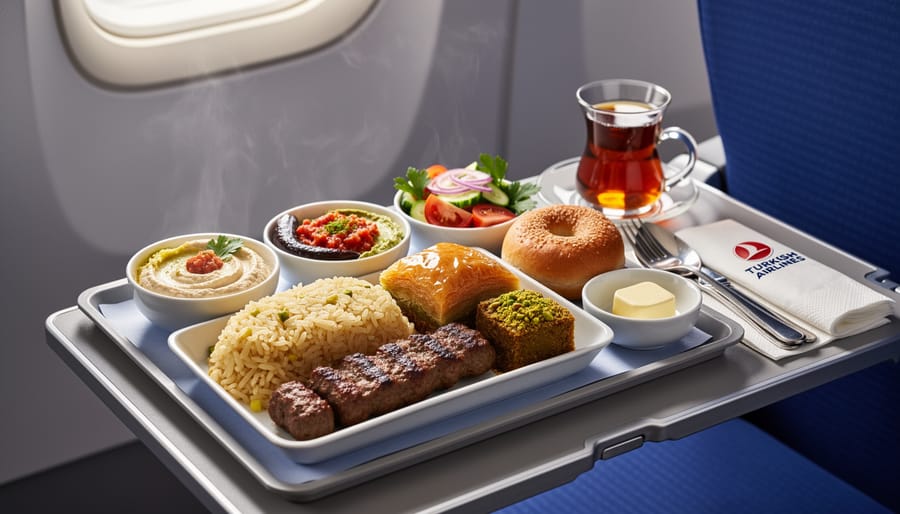
Most travelers don’t expect a mid-tier European carrier to outshine the legacy giants on food, but Turkish Airlines consistently proves that assumption wrong. We found their meal service genuinely impressive across cabins, with a variety that rivals airlines charging significantly more.
What sets Turkish Airlines apart is sheer choice. Even in economy, passengers typically select from three to four main course options on long-haul routes, far more than the standard two-choice service most carriers offer. The menus rotate frequently and showcase both Turkish specialties and international dishes, so you’re not stuck with the same tired chicken-or-pasta dilemma flight after flight.
The Turkish options themselves deserve attention. Dishes like imam bayıldı (slow-cooked eggplant in olive oil), köfte with bulgur pilaf, and mantı (Turkish dumplings) appear regularly and are executed with genuine care. These aren’t watered-down versions for Western palates; they’re proper representations of Turkish cuisine that give the journey a distinct cultural flavor. The airline also includes Turkish delight with coffee service and stocks ayran (a salted yogurt drink) alongside standard beverages.
Business class passengers get the full treatment through Turkish Airlines’ Flying Chefs program. On select long-haul routes, a trained chef prepares meals onboard, finishing dishes to order rather than simply reheating pre-plated food. The difference in presentation and taste is immediately noticeable, proteins arrive properly seared, sauces have actual texture, and vegetables retain some bite.
Here’s a practical tip we learned after several Turkish Airlines flights: always pre-order a special meal if you have even a mild dietary preference. The special meal selections, vegetarian, halal, kosher, low-sodium, are prepared separately and often feature better ingredients than the standard service. You’ll also guarantee your first choice rather than finding your preferred option already claimed by earlier passengers. Submit the request at least 24 hours before departure through the airline’s website or app.
5. American Airlines: Elevated Premium Dining in 2026
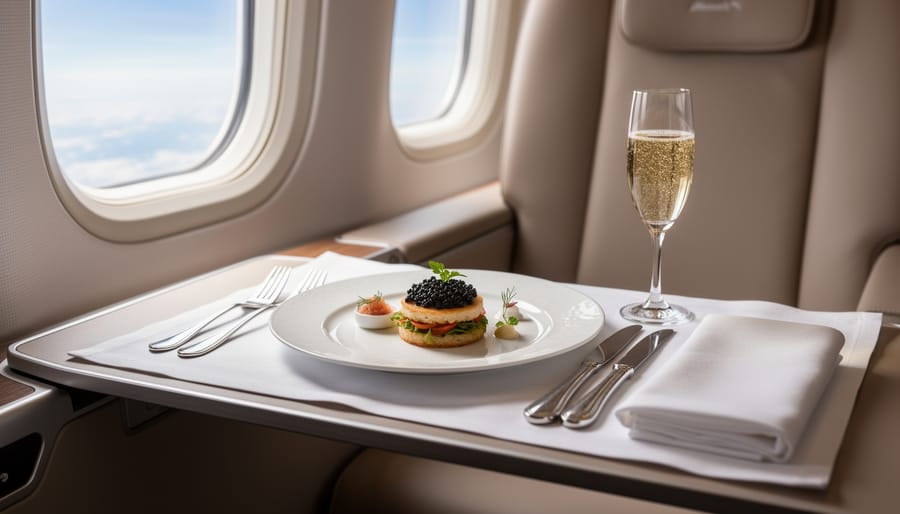
American Airlines has stepped up its game in 2026, and we’ve noticed the difference on recent long-haul flights. The carrier isn’t trying to out-caviar Emirates or match Singapore’s chef collaborations, but the targeted improvements show they’re serious about closing the premium-cabin gap.
The headline change arrived in April when American introduced caviar with blinis and deviled eggs to international Flagship First and Flagship Business cabins. We sampled this service on a Dallas to London route, and the presentation genuinely impressed us. The deviled eggs come finished with crème fraîche, which balances the caviar’s brininess nicely. It’s a smart celebratory touch for American’s centennial year, and it positions them closer to Gulf carriers on the appetizer front.
Beyond the caviar fanfare, American’s long-haul entrée selection has gotten more thoughtful. The Sweet Chile Sea Bass with light couscous, bok choy, and roasted carrots shows up frequently on Pacific routes, offering a lighter option that doesn’t leave you feeling stuffed mid-flight. The Kona-crusted Beef Fillet with sweet potato skews heartier and works well for travelers who want something substantial before sleeping. These aren’t revolutionary dishes, but they’re well-executed and a clear upgrade from the rotating pasta-chicken-beef lineup we saw in previous years.
Domestic first-class passengers also saw changes. American expanded meal service to flights over 3.5 hours earlier in the year, then pushed it further by late February to cover 2.5-hour domestic first-class meals. That captures a lot more routes where you’d previously get only a snack basket.
Main Cabin passengers weren’t forgotten. The May refresh introduced a $10 Inflight Bites box and a turkey-Havarti sandwich for purchase. We tried the sandwich on a transatlantic economy flight and found it fresh enough, though it won’t convert anyone into a believer that economy airline food is suddenly gourmet. It’s practical fuel, decently portioned, and the Havarti adds some actual flavor.
These changes don’t vault American to the top of our rankings, but they narrow the distance. For travelers loyal to American’s route network or Advantage status, the 2026 improvements mean you’re no longer sacrificing significantly on food quality when choosing them over a top-tier Asian or Middle Eastern carrier for premium-cabin international travel.
6. Qatar Airways: Middle Eastern Hospitality Meets Global Cuisine
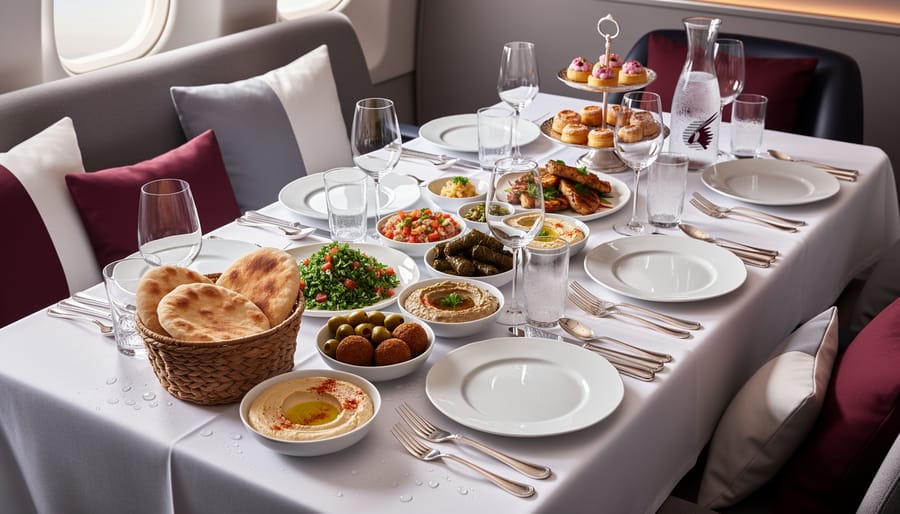
Qatar Airways consistently earns praise for striking the perfect balance between Middle Eastern hospitality and global appeal. We’ve found their approach genuinely thoughtful: instead of forcing a single culinary identity, they layer regional flavors alongside international classics, letting passengers choose their own adventure at 40,000 feet.
The Qsuite experience in business class showcases this philosophy beautifully. Mezze selections open the service with hummus, tabbouleh, stuffed vine leaves, and warm Arabic bread, but you’re just as likely to find a perfectly executed beef tenderloin or pan-seared sea bass as your main. The presentation feels refined without being overly formal, and the crew’s genuine warmth elevates every course.
What surprised us most was the consistency across cabins. Economy passengers on Qatar Airways enjoy a level of attention many carriers reserve for premium classes. The mains rotate frequently, often featuring lamb tagine, chicken biryani, or grilled fish alongside pasta and Western options. Portions are generous, and the quality holds up even on ultra-long routes like Doha to Auckland.
Their wine program deserves mention too. The business class list runs deep, with French, Italian, and New World bottles that would hold their own in a good restaurant. Even in economy, you’ll find decent selections rather than the single red-white choice some airlines offer.
The secret to Qatar’s success seems to be respecting both tradition and diversity. A passenger craving familiar comfort food won’t feel forced into exotic territory, while someone eager to explore Middle Eastern cuisine gets authentic, well-executed dishes. This flexibility makes Qatar Airways a reliable choice for mixed groups or travelers with varying tastes.
Practical tip: pre-order your meal when booking long-haul flights. Qatar’s online portal lets you browse the full menu 24 hours before departure, ensuring you get your first choice rather than settling for what’s left when the cart reaches your row.
7. Air France: Classic French Gastronomy Aloft
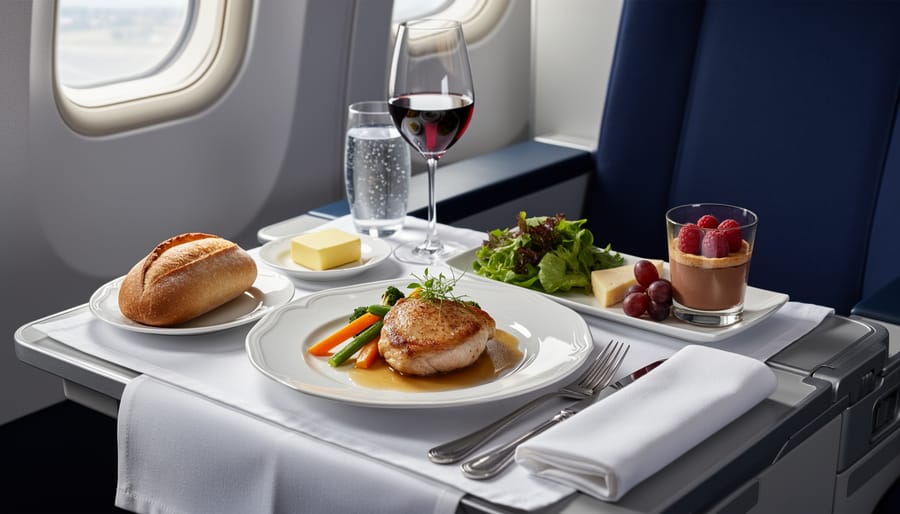
Air France earns its place on this list by doing what French culture does best: treating food as an essential part of the experience, not an afterthought. We’ve found their approach refreshingly different from carriers that chase novelty, Air France leans into tradition, partnering with acclaimed French chefs to craft menus that feel less like airplane food and more like a meal you’d seek out on the ground.
In La Première, their first-class cabin, the service genuinely mirrors a fine dining establishment. You’ll find multi-course meals featuring seasonal French ingredients, with dishes that change quarterly to reflect what’s actually fresh. The cheese course alone sets them apart: instead of a generic cheese plate, expect a curated selection of regional French cheeses presented on a proper trolley, complete with expert recommendations from the cabin crew. We’ve watched flight attendants explain the difference between a creamy Époisses and a sharp Comté with the kind of enthusiasm you’d expect from a Parisian fromagerie.
The wine program deserves special mention. Air France works with renowned sommeliers to stock over 100 wine references across the fleet, with genuine Grand Cru options in premium cabins. Even in business class, you’re choosing from 6-8 carefully selected French wines rather than settling for generic options.
Business class brings that same bistro-style attention to detail with streamlined execution. Expect classic French preparations, duck confit, coq au vin, tarte tatin, executed with proper technique. The portions feel appropriate rather than oversized, and the presentation maintains a sense of occasion even at 40,000 feet.
To maximize your Air France meal experience, check their monthly menus online before you fly and note any special chef collaborations. Request the cheese course even if you’re full, it’s genuinely worth the calories. And don’t skip the bread service; their baguettes are baked specifically for the airline and arrive surprisingly close to fresh.
Understanding Airline Meal Service: Key Terms
When you’re comparing international meal service across airlines, you’ll run into a handful of recurring terms that shape what you’ll actually experience onboard. Understanding this vocabulary makes it easier to decode airline marketing and set realistic expectations before you book.
- Flagship First/Business
- American Airlines’ premium cabin brands for international and select transcontinental routes, where you’ll find the elevated meal service including the new caviar course and signature entrees like Sweet Chile Sea Bass. These cabins offer multi-course dining rather than single-tray service.
- Book the Cook / Pre-Order Programs
- Services like Singapore Airlines’ Book the Cook let you choose your exact meal days before departure from an extended menu, guaranteeing availability and often offering regional specialties not available to passengers who wait until boarding. Turkish Airlines and JAL offer similar advance ordering options.
- Special Meal Codes
- Standard industry abbreviations for dietary restrictions: VGML (vegan), KSML (kosher), DBML (diabetic), GFML (gluten-free), among others. You request these when booking or at least 24-48 hours before departure, and they replace the standard menu entirely.
- Flying Chefs / Chef Partnerships
- Programs where airlines collaborate with notable culinary figures to design menus or, in Turkish Airlines’ case, employ onboard chefs in business class who prepare and plate dishes during the flight rather than simply reheating pre-made meals.
- Seasonal Menus
- Rotating meal programs that change quarterly or by season, common on JAL and Air France, designed to showcase ingredients at their peak and prevent menu fatigue for frequent travelers on the same routes.
- Refreshed or Enhanced Service
- Marketing language indicating updated menus or service standards, like American’s May 2026 Main Cabin refresh with the new Inflight Bites box. The actual improvement varies, sometimes it’s genuinely better ingredients and recipes, other times just repackaging.
One term worth clarifying: multi-course service doesn’t always mean multiple trips from the galley. In business and first class, you’ll typically get a proper sequence with separate starter, main, and dessert presentations. In premium economy, it might just mean your tray has distinct courses plated separately rather than everything arriving at once. The gap between these experiences is significant when you’re spending ten hours in the air, which is why understanding what each airline means by their service descriptions helps you match expectations to reality.
Tips for Getting the Best Meal Experience
I’ve learned the hard way that a little advance planning makes all the difference between a forgettable tray and a genuinely satisfying meal at 38,000 feet. The single most effective step you can take is pre-ordering your meal when your airline offers it, programs like Singapore Airlines’ Book the Cook or Turkish Airlines’ special meal requests let you lock in your preference and often guarantee better quality than the default service. Even on carriers without formal pre-order systems, requesting a special meal code (vegetarian, kosher, gluten-free) typically means your tray is prepared separately and loaded first, which often translates to fresher ingredients and more attention to detail.
If food truly matters to you, choose your cabin with that priority in mind. The leap from economy to premium economy on many carriers delivers a disproportionate meal upgrade for a modest fare increase, while business class on airlines like Emirates or American (especially with their new caviar service) transforms dining into an event rather than a chore. Before you book, check the airline’s website or call to ask about current menus on your specific route, not all international flights are equal, and some carriers rotate menus seasonally or adjust service based on flight length.
Timing your meal around sleep is critical on overnight flights. I’ve made the mistake of eating immediately after takeoff only to lie awake for hours; now I ask flight attendants if I can delay the main service or request a lighter option first, then sleep through the bulk of the flight and wake for the pre-landing meal. If you have complex dietary needs, multiple allergies, strict religious requirements, or medical restrictions, contact the airline’s special services desk directly rather than relying solely on the website form. A quick phone conversation ensures your needs are documented correctly and gives you a contact name if something goes wrong at the gate.
What to Expect by Cabin Class
Cabin class shapes your meal experience more than anything else on international flights. We’ve tested service across all tiers, and the differences go far beyond portion size, they affect timing, choice, presentation, and whether you’ll actually enjoy eating at altitude.
In economy, expect one or two meal services on long-haul routes: a main meal after takeoff and a lighter service before landing. You’ll typically choose from two entrées (sometimes three on carriers like Turkish Airlines), plus a side salad, roll, and dessert. The May 2026 American Airlines Main Cabin refresh brought options like the $10 Inflight Bites box and turkey-Havarti sandwich, giving passengers more control. Most airlines accommodate special dietary requests if you pre-order 24-48 hours ahead. The food is serviceable, occasionally good, but rarely memorable.
Premium economy steps things up with better ingredients, plating on actual dishes instead of disposable trays, and an extra snack service midway through long flights. You’ll get three or four entrée choices and a proper appetizer. It’s a meaningful upgrade if meals matter to you, though not transformative.
Business class is where dining becomes an event. Carriers like Emirates, Qatar Airways, and American (which introduced caviar service with blinis and deviled eggs in Flagship Business in April 2026) offer multicourse meals, extensive wine lists, and the flexibility to eat when you want rather than when the cart arrives. Entrées like American’s Sweet Chile Sea Bass or Kona-crusted Beef Fillet rival restaurant quality.
First class adds tablecloths, bone china, caviar on demand, and bespoke service, but the actual food quality gap between business and first narrows every year. If you’re upgrading purely for meals, business delivers better value.
Steps at a Glance

Here’s how to maximize your international flight meal experience:
1. Check the airline’s menu 72 hours before departureMost carriers post specific menus for your route online, letting you see exactly what’s served in your cabin class and whether pre-ordering is available.
2. Pre-order special meals at least 24 hours aheadWhether you need vegetarian, kosher, gluten-free, or child meals, requesting early guarantees availability and often gets you served first.
3. Choose your seat strategicallySitting toward the front of your cabin class means meal carts reach you before popular options run out, especially in economy.
4. Download the airline’s appMany carriers now let you view menus, pre-select meals, and track service timing right from your phone, which helps you handle flight delays when meal schedules shift.
5. Time your meals with your destinationOn overnight flights, consider skipping the departure meal and sleeping instead, then eating breakfast service to sync with arrival timezone.
6. Ask about upgrades at check-inIf you’re close to elite status or traveling on a light load, gate agents sometimes offer premium cabin upgrades where the meal quality jumps significantly.
Following these steps transforms meal service from a gamble into a planned part of your journey comfort strategy.
Common Questions About International Flight Meals
We’ve covered the major carriers and their meal offerings, but travelers often have practical questions about navigating international meal service. Here are the answers to questions we hear most often.
Can I bring my own food on international flights?
Yes, you can bring your own food through security and onto the plane, though liquids over 3.4 ounces must be purchased after security. Some countries restrict importing certain foods like fresh fruits, meats, or dairy products, so consume everything before landing or dispose of it properly.
How do I request special meals?
Most airlines let you request special meals when booking or by managing your reservation online at least 24-48 hours before departure. Common codes include VGML (vegan), KSML (kosher), GFML (gluten-free), and DBML (diabetic). We’ve found calling the airline directly works best for complex dietary needs.
Are premium cabin meals worth the upgrade cost?
If food quality significantly impacts your long-haul comfort, premium cabins on carriers like Singapore Airlines, Emirates, and American Airlines deliver genuinely elevated dining experiences. However, if you’re upgrading solely for meals, the cost differential rarely makes financial sense, upgrade for the overall experience instead.
What if I’m still hungry after the meal service?
Most long-haul flights offer mid-flight snacks, and galley areas typically stock crackers, cookies, and sometimes cup noodles that you can request. Business and first class passengers usually have access to more extensive snack selections throughout the flight.
One question we get surprisingly often relates to bringing specialty items like CBD products or medical cannabis on flights. International travel with these substances is complex and heavily regulated. Our CBD travel guide covers the legal landscape in detail, and if you’re curious about domestic considerations, our breakdown of medical marijuana rules explains what actually happens at security.
Regarding ingredient freshness, airlines like Emirates and Singapore Airlines source fresh produce and proteins specifically for routes, preparing meals close to departure time. American Airlines’ 2026 menu refresh emphasizes quality ingredients in dishes like their Sweet Chile Sea Bass with bok choy and roasted carrots. However, reheating constraints mean even premium meals can’t match restaurant-quality preparation.
Most airlines now publish sample menus on their websites, usually under the “Travel Experience” or “Inflight Service” sections. Singapore Airlines goes furthest with their Book the Cook program, letting you preview and pre-select specific entrees days before your flight. For American Airlines’ international flights, you can check seasonal menu rotations online, though the exact offerings may vary by route and date. Calling the airline a few days before departure often gets you the most accurate information about what will actually be served on your specific flight.
Choosing the right airline for international travel increasingly comes down to more than just price and schedule, the quality of meal service can genuinely transform a 10-hour flight from something you endure into an experience you enjoy. If luxury and culinary excellence top your list, Singapore Airlines and Emirates deliver consistently outstanding dining across all cabins, with Singapore’s Book the Cook program offering unmatched personalization. Budget-conscious travelers flying trans-Atlantic or European routes should look closely at Turkish Airlines, where even economy passengers choose from three or four mains, or Air France for solid bistro-style service without the premium price tag.
For travelers with complex dietary needs, pre-ordering through Singapore’s reservation system or JAL’s special meal options ensures you’re not stuck with the generic vegetarian tray. American Airlines has made real strides in 2026, the April caviar rollout in premium cabins and May Main Cabin refresh show they’re taking food seriously again, making them a strong choice for North American routes if you’re flying Flagship Business or First.
The honest truth from years of long-haul travel is that good food matters more than you’d think when you’re crossing time zones and trying to sleep at odd hours. A thoughtfully prepared meal, whether it’s Emirates’ mezze service or American’s Sweet Chile Sea Bass, signals care that extends to the entire journey. Pick the airline that matches your route, budget, and priorities, but don’t underestimate how much better you’ll feel arriving when you’ve been genuinely well-fed along the way.
Final Verdict
Singapore Airlines: The Gold Standard for All Cabins earns the top spot because it delivers exceptional meal quality consistently across every cabin class, from its renowned Book the Cook program and chef partnerships down to thoughtfully prepared economy service with regional specialties. This carrier suits travelers who refuse to compromise on dining regardless of which seat they book, and anyone flying long-haul routes where food genuinely shapes the journey.