Guide to the Canadian Rockies Train: Routes, Practical Information, and Travel Tips
The Canadian Rockies train journey is a scenic rail experience that runs through the heart of western Canada’s most dramatic mountain landscapes, connecting Vancouver with iconic destinations like Banff, Lake Louise, and Jasper. Rocky Mountaineer operates three distinct routes, all traveling exclusively during daylight hours so you never miss a view, with service running mid-April through mid-October when weather conditions showcase the Rockies at their finest.
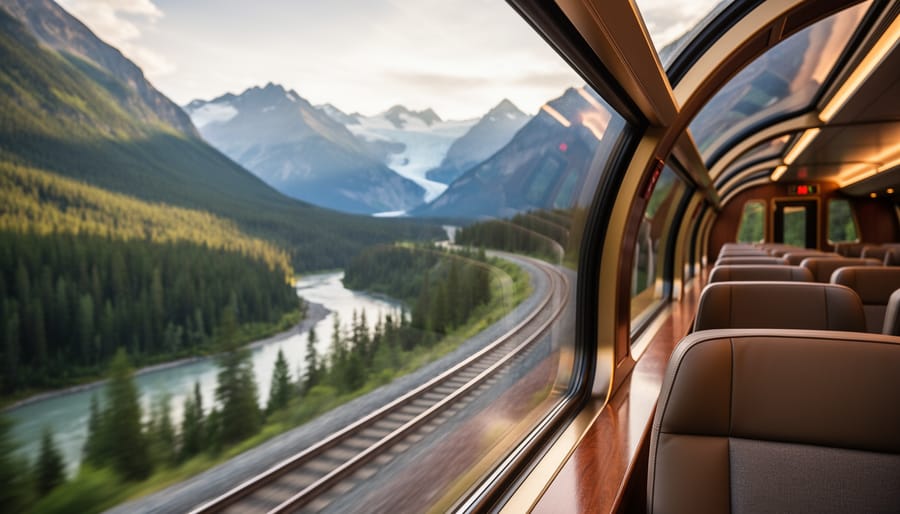
I took the First Passage to the West route from Vancouver to Banff in 2024, and what struck me most was how the landscape transforms every hour. You start in coastal rainforest, wind through the semi-arid Fraser Canyon, climb into alpine meadows, and finish surrounded by glacier-carved peaks. The glass-domed coaches mean you’re watching bighorn sheep, eagles, and rushing rivers from a comfortable seat with gourmet meals served onboard.
The routes work in both directions. Eastbound departures leave Vancouver on Mondays and Fridays (with Tuesday additions from early May through late September), while westbound trains depart Banff or Lake Louise on Wednesdays and Sundays (plus Thursdays during peak season). This flexibility lets you build the trip around your broader Canadian Rockies itinerary, whether you’re hiking in Banff National Park or exploring Vancouver before or after your rail journey.
Most travelers underestimate how much the train itself becomes the highlight, not just transportation between destinations. You’re covering routes that follow historic rail corridors through terrain that’s largely inaccessible by road, with onboard storytelling from hosts who explain the geology, history, and wildlife as you pass through.
Why Choose a Train Journey Through the Canadian Rockies
There’s something fundamentally different about watching the Rockies unfold from a train seat instead of a car window or airplane. You’re not white-knuckling a steering wheel on mountain roads or rushing to make connections. You’re simply there, suspended between towering peaks and glacial rivers, free to notice details you’d otherwise miss: a black bear foraging in a meadow, the exact moment sunlight catches a waterfall, the way the landscape shifts from dense coastal rainforest to alpine tundra over the course of a few hours.
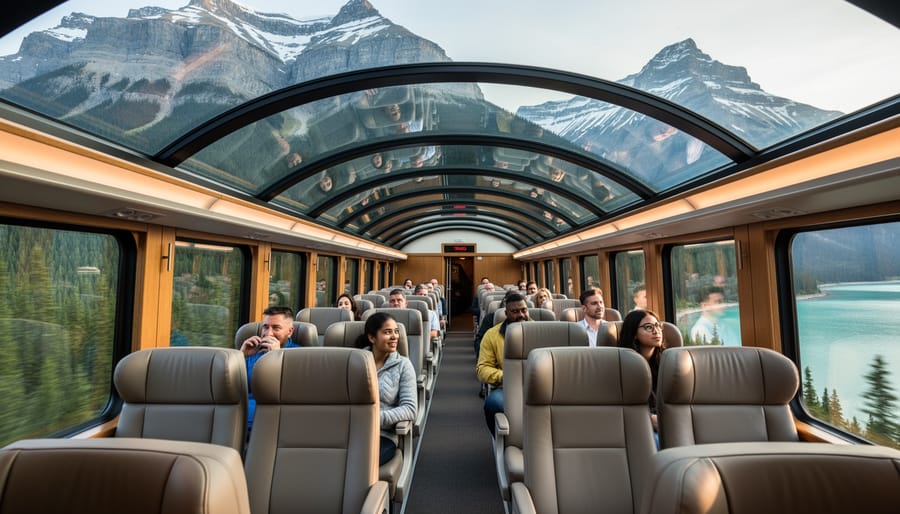
Train travel through the Canadian Rockies strips away the usual friction of mountain transportation. No navigating hairpin turns, no fuel stops in remote stretches, no elevation headaches from rapid ascent. The route itself does the work while you settle into oversized seats with panoramic windows designed specifically for these views. Glass-domed coaches on certain service levels eliminate the ceiling entirely, so you’re looking straight up at cliff faces and snow-covered ridgelines without craning your neck.
Wildlife sightings become genuinely viable when you’re not focused on the road. Onboard hosts know the zones where elk herds graze, where eagles nest, where moose frequently cross. They’ll point out landmarks and share stories about gold rush history, railway construction, and Indigenous connections to the land, turning what could be passive sightseeing into an ongoing conversation with the region.
For environmentally-conscious travelers, there’s the straightforward carbon math: trains move hundreds of passengers with far less fuel per person than individual car trips or short-haul flights. You’re covering serious ground, Vancouver to the heart of Banff National Park spans over 900 kilometers, without the environmental guilt that often shadows mountain road trips.
I’ve done the drive through Rogers Pass more times than I can count, and it’s stunning. But I’ve never arrived at the end of that drive feeling rested and ready to hike. The train delivers you to trailheads and hot springs and alpine towns with energy intact, which matters when you’re planning to actually explore once you arrive.
The Three Rocky Mountaineer Routes: Where Each One Takes You
1. First Passage to the West
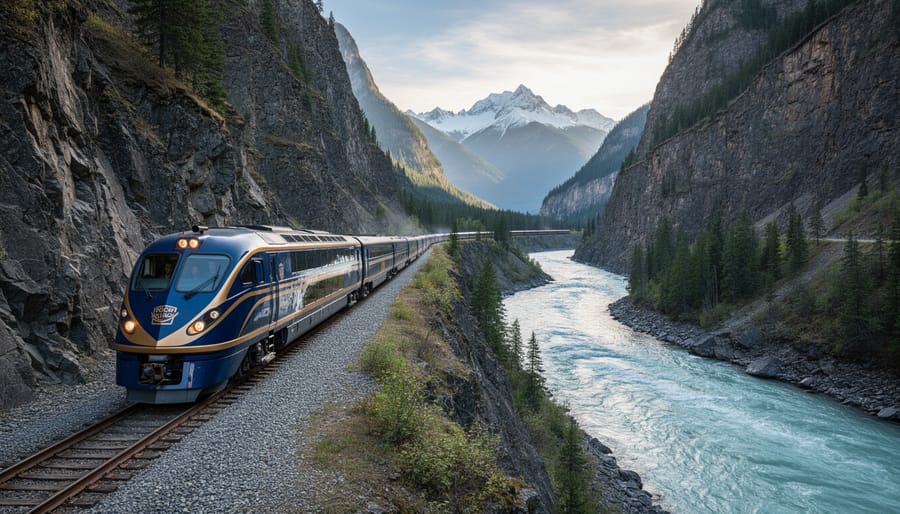
First Passage to the West stands as Rocky Mountaineer’s signature route, tracing the path of Canada’s historic transcontinental railway from coastal Vancouver through the heart of the Rockies to Banff or Lake Louise. This two-day journey covers roughly 965 kilometers of track, with an overnight stop in Kamloops breaking up the adventure. The train departs Vancouver on Mondays and Fridays from mid-April through mid-October, with additional Tuesday departures added from early May to late September for westbound travelers. If you’re starting from Banff or Lake Louise and heading west, the schedule flips to Wednesdays and Sundays, plus Thursdays during the May-to-September window.
What makes this route compelling is the sheer variety of landscapes compressed into two days. Day one follows the Fraser River through dramatic canyon walls, where the railway clings to cliffsides above rushing whitewater. You’ll pass through the semi-arid interior near Kamloops, a stark contrast to Vancouver’s coastal greenery. Day two delivers the Rockies’ full visual punch: glaciers, alpine meadows, and peaks that scrape 3,000 meters.
Key highlights along First Passage to the West include:
- Fraser Canyon’s towering rock faces and the Hell’s Gate section where the river narrows to just 35 meters
- The engineering marvel of Spiral Tunnels, where the train loops through mountain tunnels to manage steep grades
- Wildlife corridors where grizzly bears, elk, and bighorn sheep frequently appear near the tracks
- Kicking Horse Pass, the Continental Divide crossing at 1,627 meters elevation
The route works equally well in either direction. Westbound travelers get the Rockies’ drama first, then ease into the Fraser Canyon’s warmth. Eastbound, you build anticipation as mountains grow larger on the horizon, which some find more satisfying narratively.
2. Journey through the Clouds
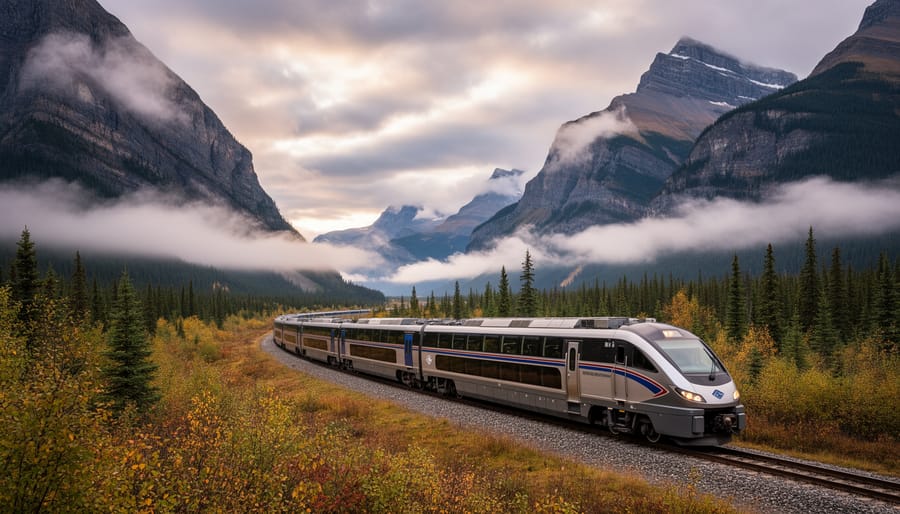
Journey through the Clouds connects Vancouver to Jasper, tracing a more northerly path than First Passage to the West. This route spends considerable time in the North Thompson River valley before pushing deeper into the Rockies, eventually reaching Jasper National Park rather than Banff. You’ll overnight in Kamloops on both routes, but Journey through the Clouds continues north the next day instead of veering southeast.
The scenery here leans wilder and less manicured. You pass Mount Robson, the highest peak in the Canadian Rockies, its glacier-draped summit often wrapped in cloud. The route skirts Pyramid Falls and follows the upper Fraser River through terrain that feels more remote than the southern corridor. There’s less human infrastructure visible from the train, fewer towns, and a stronger sense of backcountry expanse.
This route suits travelers drawn to raw mountain wilderness over postcard-perfect alpine villages. Jasper itself is quieter and smaller than Banff, making it a better fit for those who want hiking, wildlife, and solitude rather than resort-town buzz. If you’re planning to explore Jasper’s backcountry trails or soak in Miette Hot Springs afterward, Journey through the Clouds delivers you straight to the trailhead. It’s the less-traveled option, which means fewer crowds onboard during shoulder season and a slightly different passenger mix, more serious hikers, fewer first-time sightseers.
3. Rainforest to Gold Rush
The Rainforest to Gold Rush route is Rocky Mountaineer’s wildest study in contrasts, tracing a path from coastal British Columbia through some of the most dramatic landscape shifts you’ll encounter on any train journey in North America. This route runs between Vancouver and Jasper, with an overnight stop in Quesnel, and it pulls you through ecosystems that feel like separate worlds within a single day.
You begin in the lush coastal rainforest around Vancouver, dense greens, misty valleys, towering Douglas firs, and climb gradually into the arid interior. By midday, you’re rolling through the Fraser Canyon’s ochre cliffs and semi-desert terrain near Lillooet, where sagebrush and ponderosa pine replace the rainforest canopy. The temperature shifts, the light changes, and the landscape opens up into wide, sun-baked valleys that look nothing like the Rockies you might expect.
The second day brings you through the historic Cariboo region, where gold rush fever once drew thousands of prospectors into remote mountain camps. Your onboard hosts share stories of 1860s boomtowns, wagon roads carved into cliffsides, and fortunes won and lost along the Fraser River. These aren’t just scenic backdrops, they’re layers of history visible from your window.
This route suits travelers who want more than postcard mountain views. If you’re drawn to historical narratives, ecological diversity, and landscapes that surprise rather than simply impress, Rainforest to Gold Rush delivers something the other routes don’t: a journey that feels like crossing through time and climate zones in equal measure.
Service Levels and Onboard Experience
Rocky Mountaineer operates on a daylight-only schedule, meaning you travel during the day when the scenery is visible and stop at hotels overnight. This philosophy ensures you never miss a mountain pass or wildlife moment to darkness, which is exactly why my first journey felt less like transportation and more like a moving theater.
The train offers two primary service levels, and choosing between them comes down to how much you want to splurge on panoramic views versus keeping costs manageable while still enjoying the experience.
SilverLeaf Service seats you in single-level coaches with oversized windows that extend partway up the curved ceiling. Meals are served at your seat, and you have access to an outdoor viewing platform between cars where you can step out for fresh air and unobstructed photos. It’s comfortable, social, and lets you experience the journey without the premium price tag. I’ve met travelers who preferred SilverLeaf specifically because the seating felt more intimate and easier to chat with fellow passengers.
GoldLeaf Service is the top tier, featuring bi-level glass-dome coaches where you sit upstairs surrounded by floor-to-ceiling windows and a full glass roof. Meals are served downstairs in a dedicated dining room with white tablecloths and plated courses. The dome car provides that uninterrupted 360-degree view people rave about in photos, and the service is more formal. If you’re celebrating something special or want zero visual obstructions, this is the one.
| Service Level | Seating & Viewing | Meals Included | Best For |
|---|---|---|---|
| SilverLeaf | Single-level, oversized windows, outdoor platform | Served at seat, regional cuisine | Budget-conscious travelers, social atmosphere seekers |
| GoldLeaf | Bi-level glass dome, 360° views, separate dining car | Multi-course plated meals in dining room | Special occasions, photographers, luxury seekers |
Both levels include complimentary alcoholic and non-alcoholic drinks, snacks throughout the day, and storytelling from onboard hosts who narrate the passing landmarks and history. You’re not choosing between good and bad, just different styles of good. GoldLeaf gives you that jaw-drop dome experience, while SilverLeaf keeps things relaxed and still delivers the core magic of the Rockies unfolding outside your window.
Practical Travel Information
Planning a Rocky Mountaineer trip requires attention to timing and logistics, but the process is straightforward once you understand what’s included and what you’ll need to arrange yourself. The train operates from mid-April through mid-October, running only during daylight hours to maximize your view of the Rockies. Most journeys take two days, with an overnight stop in Kamloops (for First Passage to the West) or Quesnel (for other routes), where you’ll disembark for the night.
Rocky Mountaineer includes all onboard meals, beverages, and the train journey itself in your fare. However, you’ll need to arrange accommodations separately for your overnight stops and any pre- or post-trip nights in Vancouver, Banff, Lake Louise, or Jasper. Ground transfers between hotels and train stations are typically included, but confirm when booking. If you’re adding time in Banff or Jasper national parks, secure Parks Canada reservations for campgrounds or timed entry if your itinerary requires them.
Book at least six months ahead for travel between late June and early August, when demand peaks and hotel availability at stopover points shrinks. Shoulder seasons (late April, May, September, early October) offer better rates and fewer crowds. If you’re flying into Vancouver or Calgary to connect with the train, check how to track flight status before departure, and have a backup plan to handle flight delays that might affect your train boarding time.
What to Pack and Prepare For
Packing for a train journey through the Canadian Rockies is simpler than you might think, but getting it right makes a real difference. Since you’re traveling in a climate-controlled train during daylight hours only, you don’t need the full backcountry kit, but the Rockies throw temperature swings at you, especially between morning departures and afternoon sun through those glass domes.
- Layers: a light base, a warm fleece or sweater, and a windproof outer layer for platform stops
- Camera with zoom lens or smartphone with good zoom capability for distant mountain peaks and wildlife
- Refillable water bottle to stay hydrated without relying solely on beverage service
- Sunglasses and sunscreen, glass amplifies UV exposure, even on cloudy days
- Small daypack for keeping essentials at your seat
- Motion sickness remedies if you’re prone to queasiness on moving vehicles
Binoculars are genuinely useful here. I’ve watched other passengers scramble to borrow a pair when someone spots a bear or elk across a valley, so bring your own if you have them. A portable charger keeps your camera and phone ready for those rapid-fire wildlife moments.
What not to bring: Rocky Mountaineer has standard policies on restricted items, so leave anything combustible or pressurized at home. If you travel with vape gear pack it in checked luggage at your hotel rather than carrying it onboard, since the train operates like an airline in this regard. Keep your carry-on light and focused on comfort and capturing the scenery, not hauling half your suitcase.
Local Tips and Insider Advice
On the First Passage to the West route, try to snag a seat on the left side when traveling eastbound from Vancouver. That’s where you’ll catch the best views of the Fraser River canyon and the dramatic cliff-side sections. Westbound, switch to the right side for those same vistas. Journey through the Clouds offers spectacular mountain panoramas on both sides, so don’t stress too much about positioning, but the right side westbound gives you unobstructed lake views near Jasper.
Wildlife spotting peaks in early morning and late afternoon when animals are most active. Keep your camera ready near river valleys and meadow areas, particularly between Kamloops and the Rockies. I’ve found that chatting with the onboard hosts pays off, they know the route intimately and will often point out wildlife before most passengers notice. They’re also brilliant storytellers with tales about railway history and local legends, so ask questions during the quieter stretches.
If you’re planning to extend your trip with hiking the Rockies or soaking in Banff’s hot springs, build in at least two extra days at either end of your rail journey. The train runs mid-April to mid-October, but shoulder seasons in late April and early October offer fewer crowds and better rates, though you’ll sacrifice some warm-weather hiking options.
Can I do a round-trip on the Rocky Mountaineer?
The train operates one-way only, either eastbound from Vancouver or westbound from Banff, Lake Louise, or Jasper. You’ll need to arrange separate transport back if you want to return to your starting point.
Is the train suitable for kids?
Absolutely, though it’s a long day of sitting. Children who can handle extended sightseeing and appreciate scenery generally do well, especially in the glass-dome coaches.
What if I have mobility concerns?
Rocky Mountaineer accommodates guests with mobility challenges, but notify them when booking so they can arrange appropriate seating and assistance at stations.
Can I see the Northern Lights from the train?
No, the train only operates during daylight hours, stopping overnight in hotels, so aurora viewing isn’t possible onboard.
Book your journey well ahead if traveling in peak summer months, particularly July and August when demand is highest.
Traveling through the Canadian Rockies by train isn’t just about getting from point A to point B, it’s about slowing down enough to actually see what you’re passing through. I’ve hiked plenty of trails in Banff and Jasper, but there’s something different about watching the landscape unfold from a glass-dome coach, spotting a grizzly foraging in a meadow you’d never reach on foot, or hearing stories from onboard hosts who’ve spent decades in these mountains. For adventure-seekers, the train complements rather than replaces your hiking boots and camera gear; it connects the dots between trailheads, hot springs, and wildlife corridors in a way that’s genuinely low-impact and stress-free.
If you care about reducing your footprint while still experiencing one of the world’s most spectacular mountain ranges, this daylight-only rail journey delivers without the rental car emissions or highway fatigue. The key is booking early, popular departures fill up months ahead, especially for shoulder-season trips in May and late September when crowds thin and prices soften. Choose your route based on what pulls you in: coastal rainforest meeting desert canyons, or the classic Rockies spine with its turquoise lakes and hanging glaciers. Either way, you’re in for something memorable.